How to Sync Hierarchical Product Categories from Airtable into WooCommerce?
Air WP Sync for WooCommerce allows you to create and assign multi-level product category hierarchies in WooCommerce based on the structure you define in Airtable.
This means you can manage your entire category tree inside Airtable and sync it automatically to WooCommerce, including:
Parent categories
Child categories
Sub-categories
Full hierarchies (Level 1 → Level 2 → Level 3)
This guide explains how to structure Airtable and configure Air WP Sync for a clean and reliable import.
1. Prepare Category Fields in Airtable
To build a hierarchy, Airtable must contain one field per level of category depth.
Example fields:
Category Level 1 (main category)
Category Level 2 (sub-category)
Category Level 3 (optional deeper level)
The field names do not matter. Air WP Sync will detect their order based on how you map them.
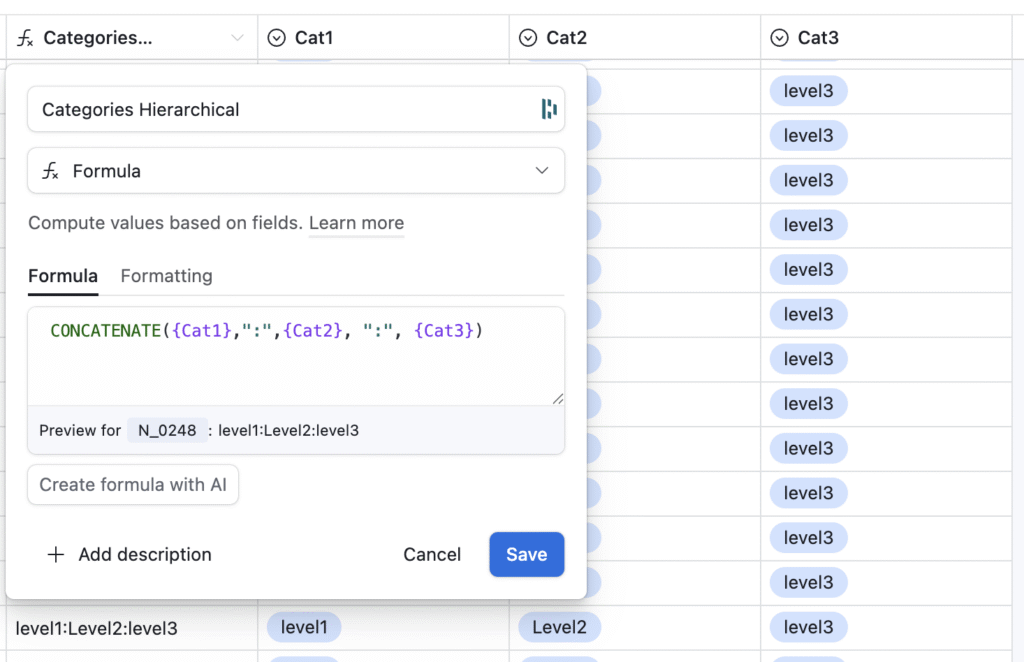
2. Create a Formula That Builds the Category Path
WooCommerce expects a single category path, so in Airtable you must create a formula that combines all levels.
This produces a clean hierarchical string such as:
Food:Vegetarian:Gluten Free
If a level is empty, WooCommerce simply ignores it.
3. Map the Hierarchical Category Field
Go to your WooCommerce connection and open the Mapping:
First, delete the original category field that is mapped by default:
Then, use the new Hierarchical categories (from hierarchical names).
Map your Airtable formula field (e.g. Categories Hierarchical) to WooCommerce’s Hierarchical Categories field.
This tells the plugin:
to read your category string,
split it into levels,
create missing categories,
assign parent/child relationships automatically.
4. How the Hierarchy Is Created in WooCommerce
When syncing, Air WP Sync for WooCommerce will:
Create Level 1 category (if it does not already exist)
Create Level 2 category and attach it under Level 1
Create Level 3 category and attach it under Level 2
Assign the deepest category level to the product
WooCommerce will automatically display the entire category tree.
5. Products With Multiple Category Paths (Optional)
To properly sync hierarchical product with several hierarchy categories branches from your Airtable base to WooCommerce using Air WP Sync for WooCommerce, follow these steps:
Step 1 – Create a Dedicated Categories Table in Airtable
In your Airtable base, create a new table called Categories.
Add the following columns:
Category Path – Formula field
Parent Category – Single line text
Child Category – Single line text
Sub-Child Category – Single line text
💡 Formula Tip: The Category Path field should concatenate the other three fields using colons (:) to represent hierarchy.
Example formula:
Step 2 – Link Categories to the Products Table
In your Products table, create a new field:
Linked Categories – Link to another record → Table: Categories
This field allows each product to be associated with one or more structured category rows.
Step 3 – Create a Rollup Field for Hierarchical Paths
In your Products table, create another column:
Category Paths – Rollup field of Linked Categories → Category Path
In the aggregation formula, use:
ARRAYJOIN(values, “|”)
This will generate a single string of hierarchical paths, separated by vertical bars (|), which is the format WooCommerce expects.
Step 4 – Update the Mapping in Air WP Sync
Go to your Air WP Sync connection and locate the Product Category field mapping.
Remove the existing mapping to “Categories”.
Add a new mapping:
WooCommerce Field → Hierarchical Categories
Airtable Column → Category Paths (the Rollup column)
Your category structure is now fully managed in Airtable, and WooCommerce will mirror any hierarchy you define.
Example:
🔎 Note: The hierarchical structure must be formatted correctly in the Category Paths rollup for WooCommerce to interpret it. If your sync doesn’t produce the correct nesting, double-check the formula and rollup.
Air WP Sync will interpret each path separately and assign all categories to the product.
6. Setup Complete
When you sync your products, WooCommerce will now generate a clean and nested category structure using your hierarchy from Airtable.
You’ll be able to assign:
Parent : Child : Sub-child
and even multiple paths using:
Parent1:Child1:Sub1 | Parent2:Child2
This workflow is ideal for:
large catalogs
frequent category structure changes
non-technical teams managing data in Airtable
multi-level product taxonomies
If you need help reviewing your Airtable fields or mapping, feel free to contact our support team.
Manage Cookie Consent
To provide the best experiences, we use technologies like cookies to store and/or access device information. Consenting to these technologies will allow us to process data such as browsing behavior or unique IDs on this site. Not consenting or withdrawing consent, may adversely affect certain features and functions.
Functional
Always active
The technical storage or access is strictly necessary for the legitimate purpose of enabling the use of a specific service explicitly requested by the subscriber or user, or for the sole purpose of carrying out the transmission of a communication over an electronic communications network.
Preferences
The technical storage or access is necessary for the legitimate purpose of storing preferences that are not requested by the subscriber or user.
Statistics
The technical storage or access that is used exclusively for statistical purposes.The technical storage or access that is used exclusively for anonymous statistical purposes. Without a subpoena, voluntary compliance on the part of your Internet Service Provider, or additional records from a third party, information stored or retrieved for this purpose alone cannot usually be used to identify you.
Marketing
The technical storage or access is required to create user profiles to send advertising, or to track the user on a website or across several websites for similar marketing purposes.
To provide the best experiences, we use technologies like cookies to store and/or access device information. Consenting to these technologies will allow us to process data such as browsing behavior or unique IDs on this site. Not consenting or withdrawing consent, may adversely affect certain features and functions.
Functional
Always active
The technical storage or access is strictly necessary for the legitimate purpose of enabling the use of a specific service explicitly requested by the subscriber or user, or for the sole purpose of carrying out the transmission of a communication over an electronic communications network.
Preferences
The technical storage or access is necessary for the legitimate purpose of storing preferences that are not requested by the subscriber or user.
Statistics
The technical storage or access that is used exclusively for statistical purposes.The technical storage or access that is used exclusively for anonymous statistical purposes. Without a subpoena, voluntary compliance on the part of your Internet Service Provider, or additional records from a third party, information stored or retrieved for this purpose alone cannot usually be used to identify you.
Marketing
The technical storage or access is required to create user profiles to send advertising, or to track the user on a website or across several websites for similar marketing purposes.